
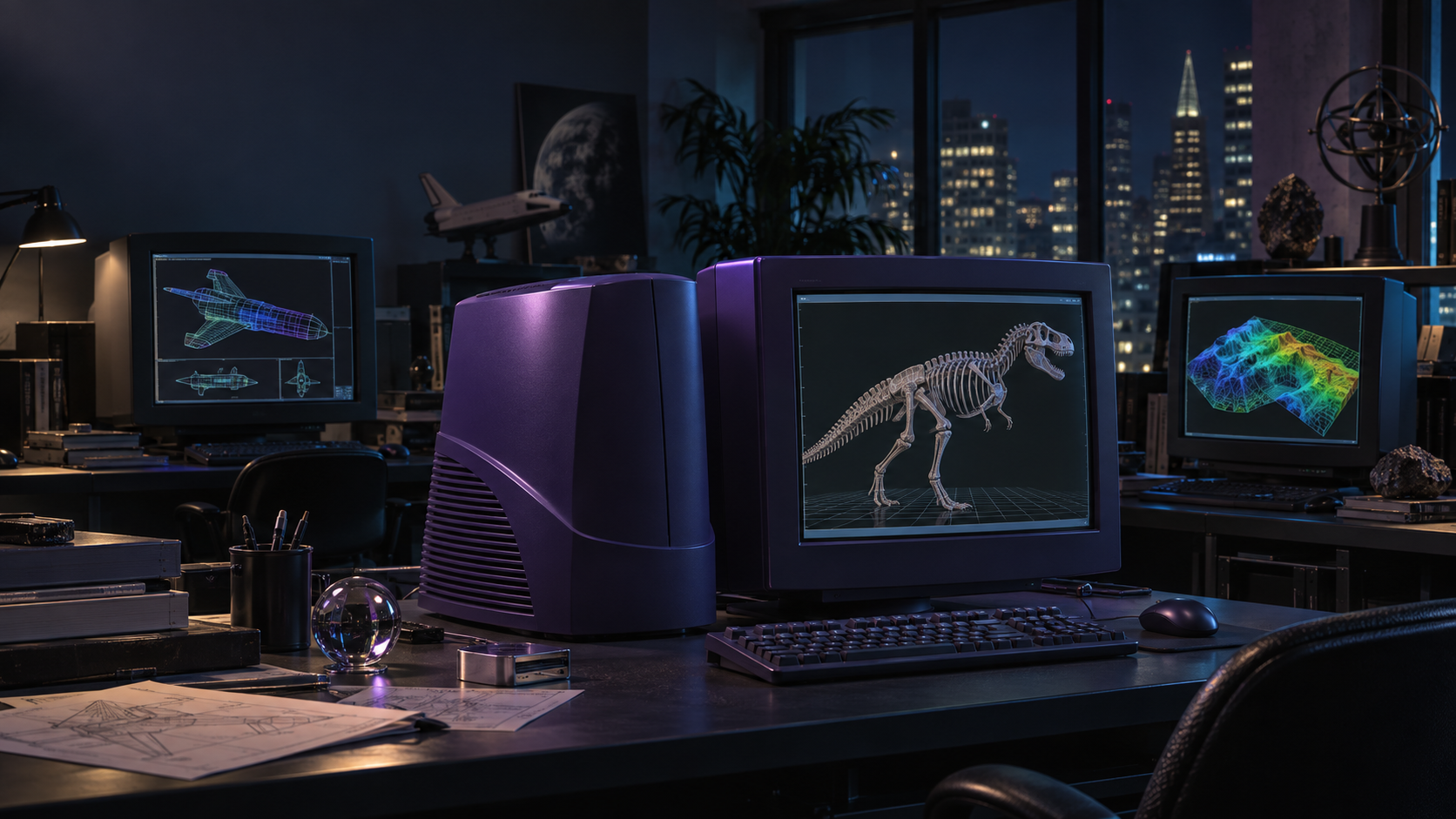
Before graphics processors became ordinary, Silicon Graphics built the computers that let artists and engineers work with the future in real time.
In the early 1990s, a computer capable of moving a textured three-dimensional scene around a screen was still a conspicuous object. It had a specialized processor, a Unix operating system, a price that required a business case and, if it came from Silicon Graphics, often a color chosen with more confidence than the beige PC industry could manage.
These machines appeared wherever images had to become interactive before they became final. Engineers rotated aircraft assemblies. Scientists moved through medical and seismic data. Television artists assembled graphics while a production clock kept running. Visual-effects teams inspected digital creatures whose finished frames might later take hours to render.
Silicon Graphics, usually called SGI, occupied the space between an idea and the image that proved the idea could work. Its machines did not render every famous frame associated with the company, and Hollywood was only one part of its market. Their deeper contribution was to make visual computing responsive enough to become a working environment.
That achievement also defined the company's eventual problem. SGI built a tightly integrated system of processors, graphics hardware, operating software and developer tools. The system was valuable because the pieces had been designed together. As standard interfaces and mass-produced graphics chips improved, much of that experience could be reproduced on cheaper computers assembled from components supplied by different companies. SGI helped establish the model for modern visual computing, then had to compete with an industry that had learned the model.
Geometry moves into silicon
James Clark's 1982 paper on the Geometry Engine begins with a list of operations: matrix transformations, clipping, projection and mapping coordinates onto a display. These are routine stages in a modern graphics pipeline. At the time, performing them quickly enough for interactive 3D required a new division of labor inside the computer.
Clark's design used a special-purpose floating-point processor and arranged twelve copies as a pipeline. One engine could transform coordinates while another handled a later stage. Geometry moved through the chain instead of waiting for a general-purpose CPU to complete every calculation in sequence. The full system was designed to transform, clip and scale a coordinate every 15 microseconds. [1]
The important idea was specialization. A conventional processor could perform the same mathematics, but it also had to be suitable for spreadsheets, compilers, databases and everything else a computer might run. The Geometry Engine spent silicon on a narrower set of repetitive operations and gained speed where interactive graphics needed it.
Clark founded Silicon Graphics in 1982 with seven students and staff members from Stanford. Marc Hannah, who had worked on the first Geometry Engine, led the second generation of the chip at the company. In his oral history, Hannah describes the other half of the problem: fast hardware had limited value if programmers could not use it through a clean graphics library. [2], [3]
That combination became SGI's method. Build hardware around the structure of graphics calculations. Give software developers a stable way to reach it. Sell the resulting workstation as a coherent system, with each layer reinforcing the others.
The first IRIS graphics terminal arrived in 1984. SGI's product line expanded from terminals into workstations and eventually large visualization systems and supercomputers. The machines changed processors, cases and graphics subsystems, but they continued to express the same proposition: interaction was part of the image-making process.
The product was waiting less
A workstation is easy to describe as a list of components. For the person using it, its value was often measured in interruptions avoided.
Consider a lighting artist turning a model while adjusting a light. If each change requires a long calculation, the artist works by prediction: make a decision, wait, inspect the result and try again. A responsive shaded viewport shortens that loop. It allows the artist to explore several bad choices quickly enough to recognize the useful one.
The same mechanism applies outside film. An engineer needs to inspect a component from an awkward angle. A geoscientist needs to travel through a volume of seismic readings. A pilot-training system needs the landscape to react immediately to control input. In each case, the computer earns its price by keeping thought and visual feedback close together.
SGI designed entire graphics architectures around that loop. Kurt Akeley's RealityEngine, described at SIGGRAPH in 1993, used 353 independent processors in its fullest configuration. It could exceed one million antialiased, texture-mapped triangles per second and was intended for tasks ranging from high-end workstations to real-time “out-the-window” simulation. [4]
Those numbers belong to a particular era, but the design goal remains familiar. A final image can be calculated slowly because it only has to exist after the computation finishes. An interactive image has to arrive while the user's decision is still active. SGI sold the ability to continue thinking without leaving the visual scene.

The workstation becomes a studio
Hollywood gave SGI its most durable public image. The company's technology was associated with the effects in Terminator 2 and *Jurassic Park*, while the wider market included industrial design, medicine, science and simulation. The Computer History Museum notes that most customers used SGI systems for computer-aided design and scientific visualization even as film work attracted the attention. [5]
The entertainment business still reveals how strong SGI's position had become. Studios such as Industrial Light & Magic turned the workstation into part of a larger production pipeline. In 1995 the US Federal Trade Commission examined SGI's proposed acquisitions of Alias Research and Wavefront Technologies, two leading makers of 3D graphics software. The FTC stated that SGI held about 90 percent of the workstation market serving sophisticated entertainment graphics. Alias, Wavefront and Microsoft's Softimage were described as industry-standard applications used for film, games and other digital media. [6]
The regulator's concern explains the shape of the market. Customers did not buy a workstation in isolation. They bought access to software, trained artists, compatible files, support and a production culture that had formed around the platform. A faster competitor could enter the market and still struggle if the essential applications were unavailable.
SGI understood the value of that ecosystem and tried to own more of it. The Alias and Wavefront transactions, valued together at nearly $500 million, brought major content-creation software under the hardware company. The FTC required protections intended to keep the software available to competing workstation makers and to preserve access for independent developers.
This was the high point of vertical integration. SGI supplied the processors through MIPS, the graphics architecture, IRIX, the programming interface and increasingly the creative software. Artists could move from modelling and animation to preview and output inside a system whose layers had been tuned around related problems.
The arrangement also concentrated risk. When customers later moved to another hardware platform, application vendors had a reason to follow them. Once the software crossed that boundary, the workstation lost part of the ecosystem that had justified its price.

OpenGL opens the door
SGI's proprietary graphics library, IRIS GL, gave programmers access to the machines. Proprietary interfaces work well when one company controls the important hardware. They become an obstacle when developers need to support several systems.
OpenGL formalized the graphics interface and separated its rendering model from the window system. Mark Segal and Kurt Akeley authored the version 1.0 specification in 1992. A specification and conformance process allowed other vendors to implement the same interface, giving developers a more portable target than IRIS GL. [7], [8]
OpenGL extended SGI's influence far beyond the installed base of its workstations. It carried the company's understanding of a graphics pipeline into competing Unix systems, PCs, games and later generations of graphics hardware. Software could preserve much of its structure while moving between machines.
That portability was useful to SGI. A widely adopted interface made its approach a standard and encouraged developers to build sophisticated 3D applications. It also reduced the cost of leaving SGI hardware once other implementations became fast enough.
The legacy is visible in an ordinary modern viewport. Objects are transformed, clipped, rasterized and shaded through a specialized graphics pipeline. The details have changed enormously, especially with programmable shaders and general-purpose GPU computation. The broad division of work resembles the system Clark and his colleagues were turning into chips four decades ago.
From the render room to the living room
SGI made one of its clearest attempts to push the technology downmarket through Nintendo. In August 1993 the companies announced Project Reality, a joint effort that would become the Nintendo 64. The planned system combined a 64-bit MIPS processor with a graphics coprocessor and other custom chips. Nintendo would fund the work and pay royalties for the licensed technology. [9]
The announcement connected several scales of computing. The MIPS family powered systems ranging from personal machines to supercomputers. SGI's Indy workstation was presented as an authoring platform for game developers. Technology developed for expensive visual computing would enter homes through a machine expected to sell for less than $250.
The Indy itself showed how relative the word “affordable” could be. Introduced in 1993 with a base price of $4,995, it included Ethernet, audio, video capabilities and a small digital camera. A tested configuration reviewed by BYTE, with more memory, storage and 24-bit graphics, reached $23,695. [10]
SGI could lower the entry price, but the workstation business still depended on margins and volumes very different from the consumer PC market. Nintendo could spread specialized graphics technology across millions of consoles. SGI had to design, manufacture and support a family of complete computers for demanding professional customers.
Project Reality demonstrated where the larger market was heading. Advanced graphics would reach more people as intellectual property and dedicated chips inside mass-produced systems. The purple workstation remained desirable, yet the underlying ideas no longer needed the purple workstation around them.

The high end keeps getting higher
As commodity computers improved, SGI continued expanding upward. It acquired MIPS Computer Systems in 1992 for $333 million, securing the processor architecture used in its machines. In 1996 it acquired Cray Research and moved further into supercomputing. [2], [11]
These decisions had a coherent technical logic. Larger visualizations, simulations and scientific problems required more processors, memory and bandwidth. SGI already knew how to build specialized systems for customers who valued performance more than standardization. Cray added another prestigious name and another class of demanding computation.
The economics were becoming less cooperative. Research and development costs had to be recovered across a relatively narrow customer base. IBM, Hewlett-Packard and Sun could spread costs across larger enterprise businesses. At the lower end, PCs combined rapidly improving Intel processors, Windows NT and graphics accelerators from specialist chip companies.
In 1998 Microsoft and Intel cited industry estimates showing 1.3 million Intel-based Windows NT workstations sold in 1997, compared with 660,000 Unix workstations. Their announcement was promotional, but the migration it described was real enough to reshape the application market. [12]
SGI announced a move from MIPS toward Intel's forthcoming Itanium architecture in 1998. It also separated MIPS into an independent company. The transition took time, and Itanium did not become the universal high-performance platform its backers expected. Meanwhile, standard x86 processors and commodity GPUs improved through enormous consumer volumes.
The system-level integration that had made SGI powerful became expensive to maintain. Every proprietary layer required engineering, testing and customer support. A PC vendor could buy a processor, a graphics card and an operating system from companies that each distributed their development costs across much larger markets.
When the future becomes a component
Jim Clark left SGI in 1994. Looking back in a Computer History Museum oral history, he argued that the company should have applied its graphics expertise to chips for the PC market. He also acknowledged the uncertainty of this counterfactual. SGI had begun as a workstation company, and moving aggressively into low-cost components would have required a different organization, business model and appetite for competition. [13]
Nvidia followed the component path. Its graphics processors benefited from PC volumes and supported interfaces including OpenGL. By 2002 Nvidia could report that its products appeared in systems from nearly every major PC manufacturer, while its Quadro line addressed professional digital-content and workstation users. [14]
This comparison can become too neat. SGI and Nvidia were founded in different markets at different moments. SGI also served workloads that a single graphics card could not replace, including large shared-memory systems, storage and scientific computing. The useful distinction concerns where each company placed the boundary of its product. SGI sold the environment. Nvidia sold an increasingly powerful component that could enter many environments.
By 2006 SGI's own restructuring documents described the accumulated pressure: investments that produced weaker results than expected, reduced customer spending, delays in new technology, competition from larger firms, a narrow market over which to spread costs, debt and high overhead. The company entered Chapter 11 reorganization on 8 May 2006. [15]
It emerged from that process but filed again in 2009. Rackable Systems acquired substantially all of the operating assets for approximately $42.5 million and adopted the SGI name. Hewlett Packard Enterprise completed its acquisition of that successor company in 2016. [16], [17]
The corporate ending arrived in stages. The technical ideas had already escaped.
The machine disappears into the workflow
SGI survives in the structure of contemporary image-making more clearly than it survives as a brand. The Geometry Engine anticipated the dedicated graphics pipeline. OpenGL gave developers a durable model for addressing graphics hardware across platforms. MIPS technology entered consumer devices. Alias and Wavefront became part of the lineage that produced Maya. Engineers trained at SGI carried their knowledge into other companies.
The most significant inheritance may be cultural. SGI treated visual computing as a complete working environment. Hardware, software and interaction had to cooperate closely enough that an artist or engineer could manipulate an idea while looking at it. Modern digital-content tools assume this immediacy. We notice the viewport mainly when it slows down.
An SGI workstation once made that experience visible as a rare and expensive machine. Today its logic is dispersed across CPUs, GPUs, drivers, APIs, applications and cloud systems supplied by many companies. The box disappeared because the capability became ordinary.
That is a demanding kind of success. Silicon Graphics built machines that seemed to come from the future. The future learned how to build them more cheaply, in pieces, everywhere.
Research
Sources & further reading
Research checked on 15 September 2026. Technical and corporate claims are linked to original papers, oral histories, contemporary reporting and regulatory filings. The account of SGI's legacy and the comparison between integrated systems and component markets are editorial analysis.
- James H. Clark — The Geometry Engine: A VLSI Geometry System for Graphics, SIGGRAPH 1982. Original technical paper; architecture, purpose and performance of the Geometry Engine.
- Computer History Museum — Silicon Graphics. Founding, first product, product range, MIPS acquisition and processor transition.
- Computer History Museum — Oral History of Marc Hannah, recorded 2022. First-person account of the Geometry Engine, rasterization work and the importance of the graphics library.
- Kurt Akeley — RealityEngine Graphics, SIGGRAPH 1993. Original architecture paper and measured performance.
- Computer History Museum — Trailblazers and Change Agents: Marc Hannah. Curatorial account connecting SGI's graphics work to professional visualization and later computing.
- US Federal Trade Commission — Silicon Graphics, Inc., 9 June 1995. Regulatory account of the Alias and Wavefront acquisitions, market structure and proposed safeguards.
- Mark Segal and Kurt Akeley — The OpenGL Graphics System: A Specification, version 1.0, June 1992. Original OpenGL specification.
- Khronos Group — History of OpenGL. Relationship between IRIS GL, OpenGL, the formal specification and cross-platform implementations.
- Silicon Graphics / archived company news — Nintendo and Silicon Graphics Join Forces, 23 August 1993. Contemporary announcement of Project Reality, its proposed architecture, business arrangement and Indy development role.
- BYTE — Indy workstation review, January 1994, pp. 183–190. Contemporary independent product review, specifications and prices.
- Cray Inc. — Annual Report on Form 10-K, 2007. Corporate history of SGI's acquisition of Cray and the 2000 sale to Tera.
- Microsoft and Intel — Technical Workstation Segment Penetration, 6 March 1998. Contemporary vendor announcement quoting IDC shipment estimates; used with its promotional context stated.
- Computer History Museum — Oral History of Jim Clark, recorded 2019. Clark's retrospective interpretation of SGI's high-end focus and the PC graphics market.
- Nvidia — Annual Report on Form 10-K, fiscal 2002. Nvidia's professional GPU range, PC OEM reach and support for OpenGL.
- Silicon Graphics — Disclosure Statement for the 2006 Reorganization, 30 June 2006. Financial condition, competitive pressures and causes identified by the company in Chapter 11.
- Rackable Systems — Form 10-Q, 2009. Completion and final purchase price of the legacy SGI asset acquisition.
- Silicon Graphics International — Form 8-K, 1 November 2016. Completion of HPE's acquisition of the successor company.
Publication notes
Image credits & rights
The article combines two original editorial visuals with two openly licensed archival photographs. No film frames are reproduced. Credits and licence terms are collected here instead of appearing beneath the illustrations.
Visual-computing studio
Credit: AI-generated editorial illustration for Eric3D, created with OpenAI ImageGen, 15 September 2026.
Provenance: Generated from a written brief without reference images. It depicts an imagined 1990s visualization room and does not document a specific SGI model or historical workplace.
Use: Supplied as project output under the OpenAI Europe Terms of Use, “Content”. Assignment of OpenAI's rights in output does not guarantee exclusivity or establish rights in third-party designs.
From integrated machine to industry stack
Credit: Original explanatory diagram created for Eric3D with Codex.
Provenance: New SVG composition based on the article's analysis of SGI's vertically integrated system, OpenGL standardization and the later component market. It is conceptual, not a historical engineering diagram.
Use: Project output with no external artwork or stock assets; no Creative Commons licence has been assigned.
SGI Indigo workstation with IRIX display
Credit: Photograph by Wolfgang Stief, via Wikimedia Commons.

Provenance: Photograph made at the Oldenburg Computer Museum on 2 October 2016 and extracted on Commons from the author's original image.
Licence: CC0 1.0 Universal. Credit is retained as editorial good practice.
SGI Onyx deskside workstation
Credit: Photograph by Dave Fischer / Retro-Computing Society of Rhode Island, via Wikimedia Commons.

Provenance: Original photograph dated 28 October 2009. No editorial crop or colour alteration was applied.
Licence: CC BY-SA 4.0. Reuse requires attribution, a licence link and identification of changes; derivative versions must use the same or a compatible licence.