Well, here is the basic idea of Blue Sky Studios.
A group of people who had learned to make computers trace rays – originally not movie rays, not beautiful rays, but radiation rays and light rays and mathematically useful rays – started a company. The company built a renderer. The renderer made commercials look real, made a melancholy rabbit look soulful, made a prehistoric squirrel look funny, and made a film studio look like a business.
Then the business became part of Fox.

Then Fox became part of Disney.
Then Disney already had Pixar and Walt Disney Animation Studios and, after a while, decided that three feature animation studios was one studio too many.
This is not a story about creative failure. It is a story about light, software, jokes, intellectual property, corporate consolidation, and one very tired squirrel.
Technically, animation history.
Economically, a merger story.
Emotionally, not great.
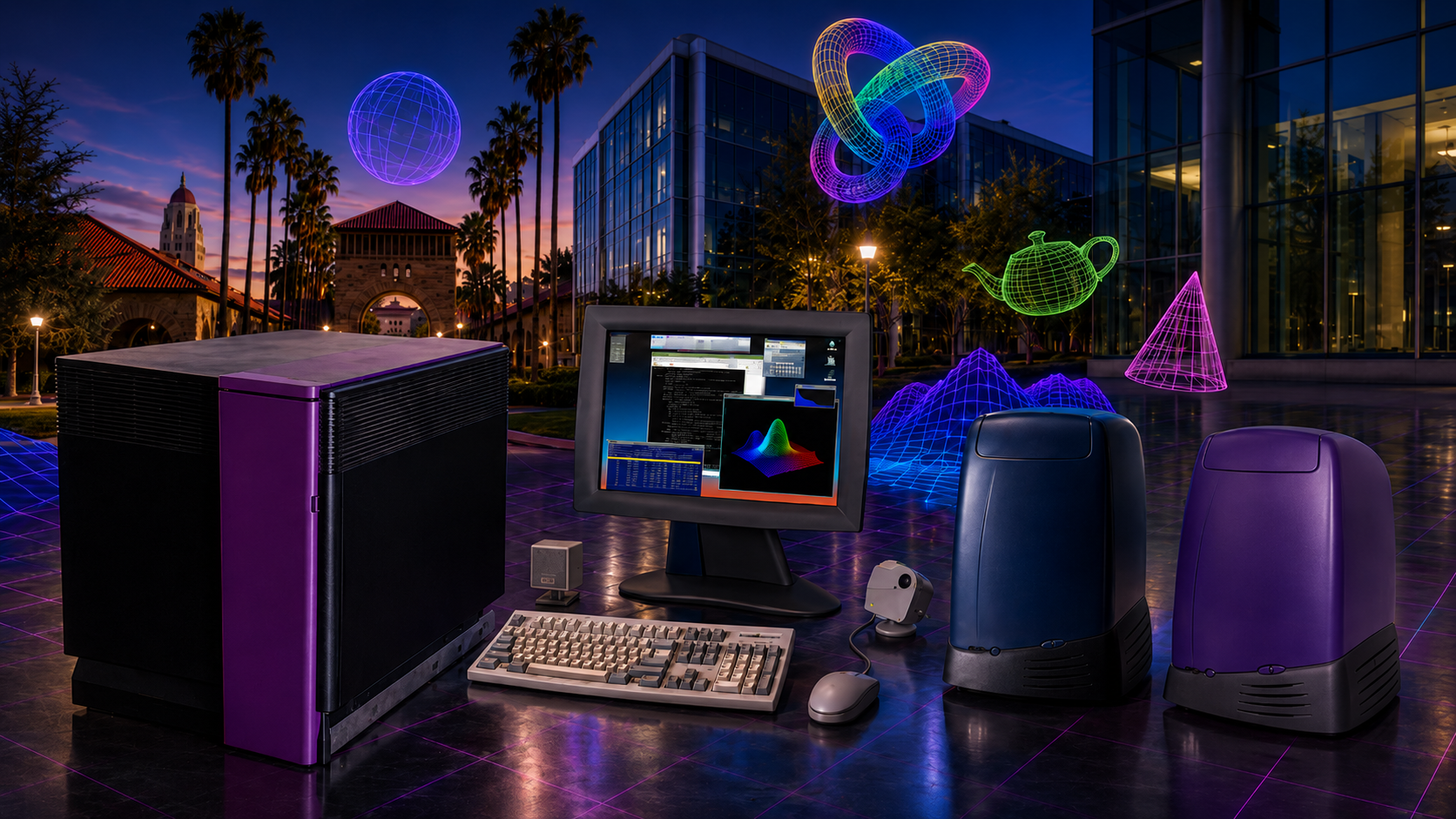
Blue Sky Studios was founded in 1987 by Chris Wedge, Michael Ferraro, Carl Ludwig, Alison Brown, David Brown, and Eugene Troubetzkoy. Before Blue Sky, several of its founders had roots in the early computer graphics world around MAGI/SynthaVision, one of the companies involved in the computer animation of Tron. Blue Sky later became Fox’s main CG animation studio, made thirteen animated features, built one of the most successful animated franchises of the 2000s, and was closed by Disney in 2021 after Disney’s acquisition of 21st Century Fox’s entertainment assets.
That is the corporate version.
The better version starts earlier, before Blue Sky was Blue Sky, when computer animation was still a strange little thing that respectable people were not sure counted as filmmaking.
Before Blue Sky, there was MAGI
The surface story is that Blue Sky was the studio behind Ice Age.
Fine. That is true in the same sense that Apple is the company behind the iPhone: true, useful, and not where the interesting part starts.
The interesting part starts with MAGI, or Mathematical Applications Group, and with Tron. MAGI/SynthaVision was one of the early computer graphics companies whose work helped define the look of Disney’s 1982 film. Chris Wedge worked there before co-founding Blue Sky. Tron became one of those origin points that computer graphics history keeps returning to, because everyone involved was inventing pieces of the future without yet knowing what the future’s business model would be.
The basic model was this:
- MAGI had math.
- Disney had a movie.
- The movie needed images that live-action photography could not provide.
So MAGI used software to produce a kind of image that felt alien, geometric, and new. It was not yet animation in the Disney sense. It was not character performance, not really. It was computer-generated space. It was light cycles and tanks and digital surfaces. It was a machine learning how to look like a movie.
This matters because Blue Sky did not begin as a character-animation studio in the classical sense. It did not start with Mickey Mouse, story departments, pencil tests, or a library of fairy tales. It started with people who had been around computational image-making. Wedge brought animation and filmmaking instincts. Ludwig brought rendering and engineering. Troubetzkoy brought scientific and mathematical gravity. The Browns and Ferraro helped turn the thing into a company.
The founding mixture was art, physics, software, production, and survival.
A normal startup mix.
Weirdly specific.
Useful.
A clean way to say it is this: Pixar was born from a computer division that wanted to make images and eventually stories. Blue Sky was born from a ray tracer that wanted to make believable light and eventually jokes.
The first myth is story.
The second myth is illumination.
The company that sold reality by the frame
Suppose you are a tiny computer animation studio in 1987. You have software. You have talent. You do not have a global franchise. You do not have a theatrical pipeline. You do not have a studio lot. You probably do not have enough computers.
What do you sell?
You sell whatever someone will pay for.
Blue Sky’s first years were not glamorous in the way feature animation history is usually glamorous. The company made commercials, logos, shorts, and visual effects. It worked in the economy of: Can you make this thing look real enough for thirty seconds?
That is not the same as: Can you make an audience cry?
But it is not unrelated.
A lot of animation history is the history of technical tricks becoming emotional tools. First you make a product look real. Then you make a creature look real. Then you make a character feel real. Then, if everything goes well, you make an audience feel something about a rabbit, a mammoth, a robot, a bird, a comic-strip boy, or a shapeshifting teenager.
There is a very Blue Sky anecdote from those early years: a commercial for an electric razor was reportedly so convincing that judges rejected it for awards because they thought it was live action rather than CGI.
This is funny in the precise way early CGI is often funny. The point of the work was to make something fake look real. Then it looked too real to be credited as fake.
Success became an administrative problem.
The razor story is an anecdote, not the whole corporate record. But it tells you something useful about Blue Sky’s identity. Blue Sky was not trying to make computers look computerish. A lot of early digital imagery had a shiny “look, computers!” quality, and that was fine because the novelty was part of the product. Blue Sky’s trick was quieter. It wanted the image to be lit correctly enough that you stopped thinking about the machine.
The computer was doing the work.
The image was supposed to deny the computer’s presence.
Technically impressive. Commercially useful. Philosophically a little sneaky.
CGI Studio: the renderer as the main character
The obvious Blue Sky mascot is Scrat.
The better Blue Sky mascot is CGI Studio.
That is less cute, and it is harder to put on a lunchbox, but it is more accurate. Blue Sky’s in-house renderer was not just a production tool. It was the studio’s worldview. It was the way Blue Sky understood surfaces, shadows, glass, metal, fur, snow, atmosphere, and the little emotional difference between an image that looks computed and an image that looks lit.
Here is the basic technical idea, in non-technical terms. A renderer is the part of the animation pipeline that turns geometry, materials, lights, and camera information into final images. Some renderers are very good at faking light efficiently. Some are very good at calculating how light behaves. Blue Sky’s identity was built around ray tracing: following rays of light as they interact with surfaces.

That matters because Blue Sky’s rendering culture gave the studio a particular aesthetic:
- soft shadows
- naturalistic reflected light
- believable glass and metal
- warm interiors
- snow and ice that did not look like plastic
- surfaces that felt physically present
This was not merely a nice feature. It made Bunny possible. It made Robots possible. It helped Ice Age feel colder, brighter, and more tactile. It later helped make The Peanuts Movie weirdly faithful by letting the studio decide when not to show off.
The boring version is: Blue Sky had proprietary rendering software.
The interesting version is: Blue Sky’s business was built on making light believable enough that characters could eventually become believable too.
The funnier version is: the studio’s most important employee was a renderer. It did not get screen credit the way Scrat did.
This seems unfair, though probably the renderer did not mind.
Bunny: the short that proved the machine had a soul
Before Ice Age, there was Bunny.
This is the first moment where Blue Sky’s technology becomes emotionally legible. Bunny, directed by Chris Wedge, is a seven-minute animated short about an elderly rabbit living alone in a cabin, bothered by a moth while she bakes. That description makes it sound like slapstick.
It is not, or not only.
It becomes a film about memory, death, grief, and reunion.
It is a technological demo wearing the clothes of a ghost story.
A soft one.
Bunny won the Academy Award for Best Animated Short Film. But the Oscar is not the most interesting thing about it. Awards are nice. Mechanisms are better. The mechanism of Bunny was that Blue Sky used ray tracing and radiosity to produce a look that was not cold, not plastic, not “computer graphics” in the old sense.
Chris Wedge wanted the film to feel like a dream or a memory. That phrase is doing a lot of work. It tells you that the rendering problem and the emotional problem were the same problem.
If the light felt wrong, the memory would feel wrong.
If the memory felt wrong, the story would not work.
The technology was not decoration. It was tone.
That is the important turn: Blue Sky’s software stopped being only a commercial advantage and became a storytelling instrument.
There is another lovely detail: Bunny features music by Tom Waits and Kathleen Brennan. The film is computationally advanced and emotionally old-fashioned. It is about an old rabbit, a kitchen, a moth, a photograph, and a glow from somewhere else.
This is not the brand identity that would later sell toys. It is quieter than that. But it is the moment Blue Sky becomes a studio rather than a vendor.
A vendor can render a razor.
A studio can render grief.
Fox, VIFX, and the road from service work to features
The basic problem for a service studio is that service work pays bills but rarely builds ownership. You do the shot. Someone else owns the movie. You do the commercial. Someone else owns the product. You create value, but not necessarily the kind of value that compounds.
Blue Sky wanted to make features.
It did not happen immediately.
In the late 1990s, the company moved closer to Fox through VIFX, Fox’s visual effects business. This is where the studio’s business changes category. It starts as a technical services company. Under Fox, it becomes a possible feature animation supplier.
The asset changes.
At first, the asset is software plus talent.
Then the asset is software plus talent plus the possibility of owned animated films.
That is a better asset.
More volatile, more expensive, more dangerous.
But better.
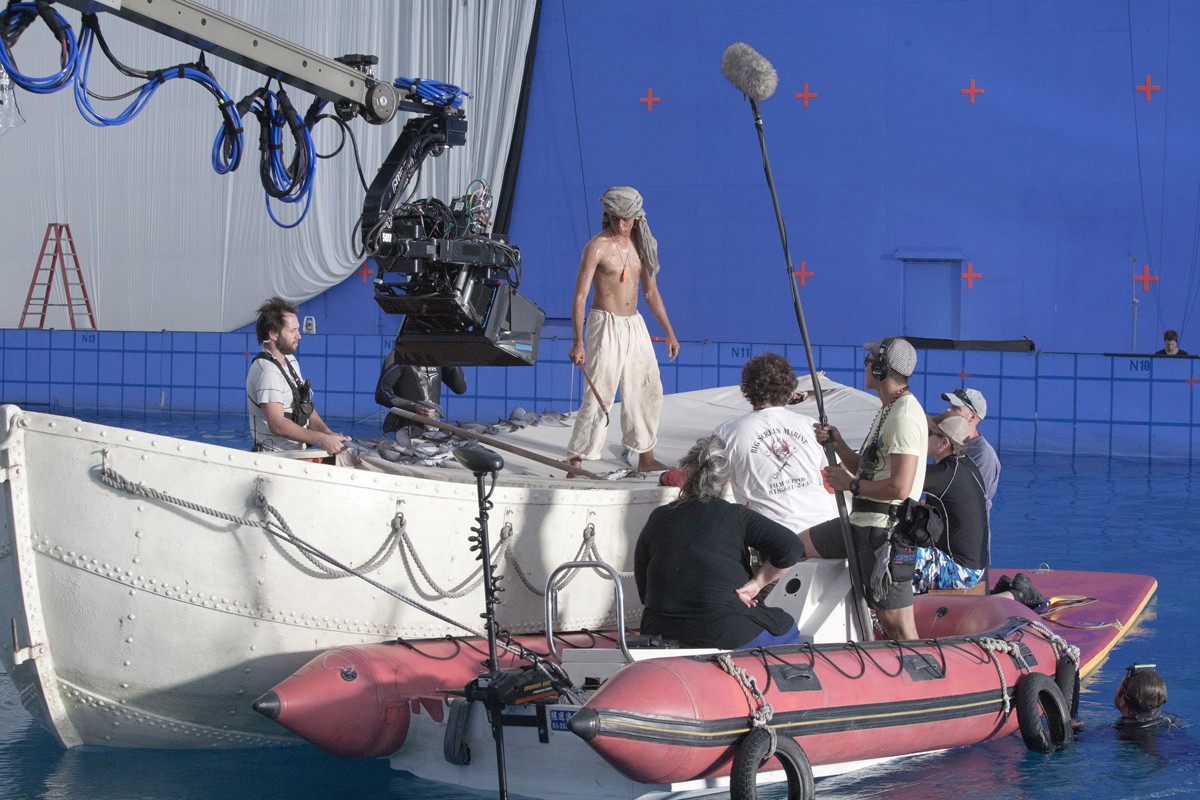
Blue Sky also worked on film visual effects in the 1990s, including creature and effects work that bridged the gap between its commercial/VFX period and its later identity as a character-animation studio. This is useful context. Blue Sky could do creatures. It could do materials. It could do character animation. It could do the technical thing.
What it still had to prove was that it could do the feature thing.
Then Fox gave it Ice Age.
Ice Age: the company becomes a studio
At first glance, Ice Age is the story of a mammoth, a sloth, and a saber-toothed tiger returning a human baby.
But the better way to think about it is that Ice Age was Blue Sky’s proof-of-business. It was the point where the company said: we can do not just images, not just shorts, not just commercials, not just effects, but a full animated feature.
That is a different problem.
A seven-minute short can be a jewel.
A commercial can be a trick.
A feature is a factory pretending to be a story.
The early version of Ice Age was reportedly darker than the film that audiences eventually saw. Chris Wedge later recalled that the first version had very little comedy and a grim tone. Of course this had to change. A children’s animated comedy in which everything is death and despair is, technically, bold.
Commercially, maybe less so.
So Blue Sky had to learn the feature animation trade in real time. It had to make characters readable, scenes funny, environments workable, and a story smooth enough for families. The company had spent years mastering the image. Ice Age taught it that the image was not enough.
The audience did not care how hard the render was.
The audience cared whether Manny, Sid, Diego, and the baby worked.
This is unfair to renderers. Audiences are like that.
Commercially, Ice Age worked. The film became a major global hit and established Blue Sky as Fox’s feature animation studio. More importantly, it turned a company with a great renderer into a company with a franchise.
That is the key category shift:
- the renderer becomes credibility;
- credibility becomes a short film;
- the short film becomes prestige;
- prestige helps make a feature possible;
- the feature becomes box office;
- box office becomes IP;
- IP becomes corporate logic.
This is animation.
Also finance.
Scrat: the accidental balance sheet of Blue Sky
Now Scrat.
Scrat is not the main character of Ice Age. This is one of those facts that is true but feels false. Manny, Sid, and Diego carry the story. Scrat carries the brand.
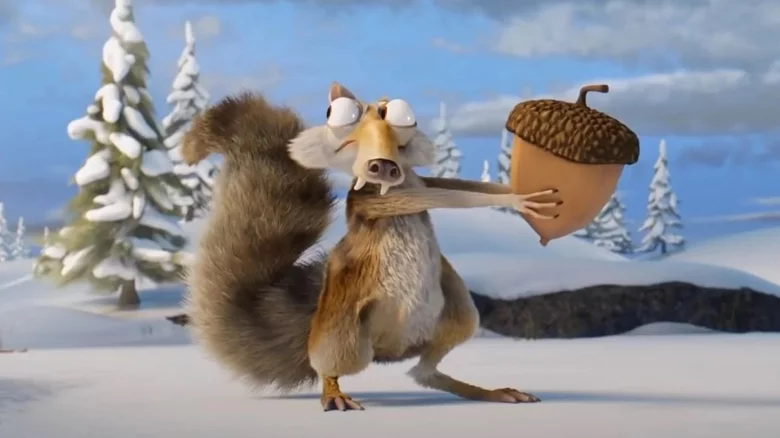
He is a small saber-toothed squirrel-rat thing obsessed with an acorn. He does not speak. He fails constantly. He is crushed, frozen, launched, stretched, buried, electrocuted, and cosmically punished. He wants one asset. The asset is an acorn. He never gets to keep it.
This is a very simple business model.
It worked.
The origin of Scrat has become its own small mythology. The clean version is that he emerged from a combination of story need, character design, physical comedy, and Peter de Sève’s drawings, with Chris Wedge’s voice sounds becoming part of the character’s identity. Like many animated characters, Scrat was not one person’s isolated invention. He was a studio mechanism: design, story, performance, animation, timing, and pain.
Mostly pain.
The funny thing about Scrat is that he is almost pure mechanism.
Character wants object.
Character almost gets object.
Character loses object.
Repeat.
If the character talks, the joke gets more complicated. If the object changes, the joke gets more complicated. If he succeeds, the joke ends. So he does not succeed. For twenty years.
This is cruel.
Also useful.
The best mascots are simple enough to survive context. Scrat can appear before the movie, outside the movie, in a trailer, in a short, on a poster, in a gag, in a memory. You do not need to explain him. He wants the acorn. The universe says no. That is the franchise.
The absurd consequence is this: a studio born from ray tracing and radiosity became globally identified with a silent slapstick animal suffering liquidity problems in the acorn market.
Financially, Scrat was very good.
Personally, terrible for Scrat.
The problem of being known for one thing
Success creates a problem.
It is one of the nicer problems. Still a problem.
After Ice Age, Blue Sky had a brand. The brand was family-friendly CG comedy with physical humor, eccentric characters, and a slightly softer, less sarcastic tone than DreamWorks. But if a studio becomes too identified with one franchise, the franchise becomes both asset and constraint.
The basic studio problem is this:
- You need hits.
- Sequels are more predictable than originals.
- But if you make too many sequels, people decide that the studio is only the sequel machine.
- And if the sequel machine stops working, everyone asks why you did not build something else.
This is easy to say from outside the building.
Inside the building, sequels pay salaries.
So the middle of Blue Sky’s history is not just a list of films. It is the search for a second identity.
Blue Sky has Ice Age.
Blue Sky wants not to be only Ice Age.
The market likes Ice Age.
This is awkward.
Robots: we can build a world
Robots was Blue Sky’s first major answer to the “what else are you?” question.
The answer was: we can build a world.
Directed by Chris Wedge and built from a story world associated with William Joyce, Robots created a city of mechanical bodies, spare parts, industrial textures, and invented urban design. It was not based on animals, toys, bugs, fish, or people. Everything had to be designed.
This is exactly the sort of movie Blue Sky’s renderer wanted.
Metal.
Glass.
Rust.
Reflection.
Grime.
Surfaces.
Tiny mechanical details.
If Ice Age was Blue Sky proving it could do story, Robots was Blue Sky proving it could build a world that was all design.
The movie’s central aesthetic question was: can something completely invented still feel physically familiar?
The answer was light.
Again.
Blue Sky’s recurring little trick was this: the world can be absurd if the light is plausible. A robot city can be ridiculous if the materials behave. A rabbit ghost story can be stylized if the shadows are soft. A squirrel can survive geological disasters if the timing is right.
Technically, this works.
Emotionally, it depends on the jokes.
Rio: we can build color and place
Then there is Rio, which is a different kind of answer.
If Robots says “we can build a world from scratch,” Rio says “we can build a world from memory.”
Carlos Saldanha, born in Rio de Janeiro, had been one of Blue Sky’s key creative figures. With Rio, he had a chance to turn a personal geography into an animated world. That matters because Rio gave Blue Sky another identity.
Not ice.
Not prehistoric migration.
Not gray-blue snowfields and herd dynamics.
Color, music, birds, carnival, geography, flight.
If Ice Age was Blue Sky’s slapstick survival brand, Rio was Blue Sky’s location-and-color brand.
The basic mechanism is simple. Saldanha wants to bring Rio to animated life. Blue Sky has the rendering and animation machinery to make that world bright, musical, and marketable. Fox wants another franchise. The bird gives everyone a way to do it.
This is not as clean as Scrat.
Nothing is as clean as Scrat.
But Rio became one of Blue Sky’s most important non-Ice Age identities, because it broadened the company’s visual and emotional vocabulary. The studio was not just the acorn company.
It was trying.
The Peanuts Movie: we can make technology disappear
The Peanuts Movie is one of the most interesting films Blue Sky ever made, because it reverses the studio’s usual technical incentive.
Normally, computer animation wants to show you what it can do: more depth, more camera movement, more texture, more light, more physical simulation, more everything.
The Peanuts Movie had a different problem. It had to make 3D computer animation look like it remembered being a comic strip.
That is harder than it sounds.
Charles Schulz’s drawings are not “simple” in the sense that a computer can simply extrude them into 3D. They work because of line, angle, pose, iconic distortion, and the fact that the drawing only has to work from the view Schulz chose. A CG model, by contrast, normally has to work from every angle.
This is where things get weird.
A normal 3D Charlie Brown head could be technically consistent and aesthetically wrong. So Blue Sky used view-dependent solutions, multiple shapes, sliding features, 2D-style motion lines, smear frames, and a set of tricks designed to preserve the feeling of Schulz’s drawings without flattening the whole film into imitation.
This is wonderful because it is the opposite of naive technological progress.
The studio did not say: we can make Peanuts more realistic.
It said: we can use a lot of technology to preserve the unreality correctly.
That is a very Blue Sky thing, but in reverse. In the early days, Blue Sky used ray tracing to make fake razors look real. In The Peanuts Movie, it used CG sophistication to make 3D characters look less like standard 3D characters.
The software was doing a lot of work to look like it was not doing work.
The result is one of the best arguments for Blue Sky as a craft studio rather than merely a franchise studio. The most advanced choice was restraint. The most technical achievement was staying faithful to a line.
This is not a normal blockbuster incentive.
It is very expensive nostalgia.
Pretty good.
The other films, or the danger of “fine”
A complete Blue Sky story should not reduce the studio to five titles. It made Horton Hears a Who!, Epic, Ferdinand, and Spies in Disguise too. These films matter because they show the studio’s range and its structural difficulty.
Horton Hears a Who! let Blue Sky adapt Dr. Seuss, another case where 3D had to negotiate with a famous 2D visual language.
Epic leaned into a more realistic, action-adventure fantasy mode.
Ferdinand was gentler and character-driven.
Spies in Disguise, released in 2019, became the studio’s final released feature.
The structural issue is that Blue Sky occupied an awkward middle position. It was not Disney Animation, with a century of brand equity. It was not Pixar, with the “story brain trust” mythology and a prestige aura. It was not DreamWorks, with a loud pop-cultural personality and a larger slate.
It was Fox’s main CG feature animation arm, on the East Coast, with a strong technical culture, a giant franchise, and a handful of original or adapted films that sometimes worked very well and sometimes did fine.
“Fine” is a dangerous word in corporate entertainment.
Fine can be profitable.
Fine can employ hundreds of artists.
Fine can create beloved films for specific audiences.
Fine can also become expendable when a parent company merges with a larger parent company that already owns two more famous animation studios.
This is not fair.
It is also not mysterious.
Disney buys Fox, and Blue Sky becomes redundant
Here is the business version.
Disney’s acquisition of 21st Century Fox became effective in March 2019. The deal brought Fox’s film and television assets into Disney’s already enormous entertainment structure. This is the moment Blue Sky’s fate becomes less about Blue Sky.
Before the deal, Blue Sky was Fox’s feature animation studio.
After the deal, Blue Sky was inside Disney, which already owned Walt Disney Animation Studios and Pixar.
This is the key mechanism.
The surface story is: Disney closed Blue Sky because of economic realities and pandemic pressure.
The better way to think about it is: Disney inherited a third feature animation studio in a market where maintaining that third studio no longer fit the company’s cost structure and strategic priorities.
Both are true.
One is the statement.
The other is the mechanism.
In 2021, Disney announced it would close Blue Sky. The shutdown affected hundreds of employees and halted work on Nimona, which had been in production at the studio.
So, legally, Disney owned the studio.
Economically, Disney did not need three feature animation pipelines.
Culturally, Blue Sky still had fans, artists, history, and value.
Financially, that was not enough.
This is the grim rule of consolidation: the acquired company can be good and still redundant. Good is not the same as strategically necessary.
That is bad.
Obviously.
Nimona: the film that outlived the studio
If Bunny is Blue Sky’s origin myth as an artistic studio, Nimona is its ghost story.
Nimona began as ND Stevenson’s webcomic and graphic novel, a shape-shifting story with queer themes, medieval-futurist design, and a heroine whose whole identity resists stable categorization. Fox Animation planned to adapt it, with Blue Sky producing. Then Disney acquired Fox. Then Disney closed Blue Sky. Then the film was effectively dead.
Then it was not.
The project was later rescued by Netflix and Annapurna, with DNEG Animation helping complete the film. This is one of those production histories that feels almost too thematically neat. Nimona is about a shapeshifter who is feared because she refuses to be one stable, legible thing. The production history is about a film that had to change institutional form to survive.
Fox/Blue Sky project.
Disney casualty.
Annapurna/Netflix/DNEG release.
The character shapeshifts.
The movie shapeshifted.
The studio did not survive.
The film did.
There is also a more delicate part of the story. Former Blue Sky staffers later said that Disney leadership had raised concerns about LGBTQ elements of Nimona. That should not be overstated into a simple claim that Disney killed the movie because it was queer. The clean version is more careful and more accurate:
- Disney acquired Fox.
- Disney closed Blue Sky.
- Nimona was halted.
- Former staffers later described concerns around LGBTQ elements.
- Netflix, Annapurna, and DNEG eventually revived and released the film.
That is already enough.
The mechanism is interesting without overclaiming.
And the finished film became an almost too-perfect epilogue. Nimona was later nominated for the Academy Award for Best Animated Feature. A studio closes. Its almost-lost final project escapes. The escaped project gets an Oscar nomination.
Good structure.
Painful financing.
Scrat finally gets the acorn
And then, after all of this, Scrat got the acorn.
In the final days of Blue Sky, a small group of artists created a farewell clip in which Scrat finally catches and eats his acorn. The shot is short, quiet, and emotionally ridiculous in the way only animation can be emotionally ridiculous.
This is almost offensively perfect.
For twenty years, the joke was that Scrat could never have the thing he wanted. He could chase it, touch it, lose it, destroy the landscape for it, and suffer for it, but not keep it. Then the studio closed, and the artists let him have it.
The basic model is:
- character wants asset;
- universe denies asset;
- franchise monetizes denial;
- studio dies;
- artists settle the account.
Legally, just a short.
Economically, a farewell.
Emotionally, a tiny restructuring of the acorn liability.
The scene works because it is not loud. Scrat eats the acorn, looks satisfied, and leaves. No catastrophe. No reversal. No punishment. The joke ends because the studio ended.
This is as clean a final image as animation history gives you.
The IP survives the studio
Of course the characters did not die with Blue Sky.
Characters are corporate assets.
Corporate assets are hardy.
Disney retained Blue Sky’s library and intellectual property through its ownership of the former Fox assets. The Ice Age brand continued after Blue Sky’s closure, and another Ice Age film was later announced with returning original stars.
This is the awkward distinction between a studio and its assets.
A studio is people, tools, habits, jokes, workflows, arguments, taste, lighting tricks, lunchrooms, production crises, and institutional memory.
IP is a thing a company can own after the people go elsewhere.
Both are real.
They are not the same kind of real.
Disney can make more Ice Age. It owns the property. That is the legal answer.
Can Disney make more Blue Sky?
No.
Not exactly.
The people dispersed. The renderer culture ended. The East Coast feature animation hub disappeared. The building is not the studio. The brand is not the studio. The acorn is not the chase.
That is the human answer.
What Blue Sky actually contributed
So what is Blue Sky’s place in animation history?
The lazy answer is: the studio that made Ice Age.
The better answer has several parts.
First, Blue Sky was a technical studio whose rendering culture mattered. CGI Studio, ray tracing, radiosity, and physically plausible light were not side notes; they were foundational to how the studio saw images.
Second, Blue Sky showed how a service studio could become a feature animation studio. It went from commercials and VFX to shorts to Ice Age. That path is important because much of CG animation history is not the history of pure animation studios. It is the history of technical vendors becoming storytellers.
Third, Blue Sky gave Fox a real animation identity. Fox had animation before Blue Sky, of course, but Blue Sky became the durable CG feature engine. Without Blue Sky, Fox’s place in the 2000s and 2010s animation market looks very different.
Fourth, Blue Sky created one of the most efficient animated mascots of the CG era. Scrat is almost pure silent-film logic transplanted into digital animation. He is Chaplin, Wile E. Coyote, and a bad commodities trader in one animal.
Fifth, Blue Sky had range that is easy to underrate. Bunny is melancholic. Ice Age is a comic road movie. Robots is design-world maximalism. Rio is color and music. The Peanuts Movie is technical restraint. Nimona is the lost-and-found shapeshifter epilogue.
Sixth, Blue Sky’s closure is one of the clearest examples of what media consolidation does to creative infrastructure. It does not merely combine libraries. It decides which production cultures are necessary and which are duplicative.
The duplicative ones can be excellent.
They can still close.
That is the general rule: in a consolidated media company, being valuable is not the same as being indispensable.
The Blue Sky mechanism
Here is the whole mechanism, schematically.
MAGI helps make computer images for Tron.
Some of the people from that world create Blue Sky.
Blue Sky builds CGI Studio.
CGI Studio makes light believable.
Believable light helps make Bunny emotionally credible.
Bunny gives the studio prestige.
Fox gives the studio a feature opportunity.
Ice Age gives it a franchise.
Scrat gives it a mascot.
The mascot gives it a global shorthand.
The studio tries to find second identities: mechanical worlds, Brazilian color, Schulzian restraint.
Disney buys Fox.
Blue Sky becomes the third feature animation studio inside a company that already has two stronger animation brands.
Disney closes Blue Sky.
Nimona escapes.
Scrat eats the acorn.
The IP continues.
The studio does not.
That is the trade.
It worked until it didn’t.
This is not a moral judgment. It is just the mechanism.
The weird thing is that Blue Sky’s beginning and ending mirror each other. At the beginning, a group of artists and technologists took tools from a changing early-CG world and built a new studio. At the end, artists and projects left a closing studio and carried pieces of it elsewhere. The company was born from one institutional ending and ended by creating several new afterlives.
Nimona is one afterlife.
Ice Age is another, though more corporate.
The careers of former Blue Sky artists are another.
The influence of Blue Sky’s rendering culture is another.
The memory of Scrat eating the acorn is another.
A studio can close and still have afterlives.
Legally, no.
Culturally, yes.
Final image
The best final image is not the Disney acquisition. It is not the press statement. It is not the franchise box office. It is not even Nimona’s Oscar nomination.
It is Scrat with the acorn.
Because that shot contains the whole Blue Sky story in miniature. A small character wants something absurdly simple. A huge system keeps it from him. The chase becomes the product. The product becomes valuable. The people making the product eventually lose the institution that made the chase possible. Then, at the end, they give the character the thing.
It is sentimental.
Of course it is sentimental.
Animation is a machine for making sentiment out of drawings, rigs, lights, surfaces, voices, and time.
Blue Sky Studios began by chasing light.
It ended by letting Scrat stop chasing.
That was the studio.
Funny little thing.
Big shadow.
Sources, references, and image credits
Article sources and references
Chris Wedge – Purchase College profile
Used for Chris Wedge’s background, his MAGI/SynthaVision work, his involvement with TRON, and his later role at Blue Sky Studios.
Ars Electronica Archive – Blue Sky / J. Christian Wedge profile PDF
Used for historical context on Chris Wedge, MAGI-SynthaVision, early computer animation, and Blue Sky’s pre-feature era.
MAGI Synthavision Demo Reel 1982 – Internet Archive
Used as archival background for MAGI/SynthaVision and early computer graphics aesthetics.
Disney Movies – TRON official page
Used for official film information and historical reference to TRON.
Animation World Network – “Blue Sky Finishes Bunny Short”
Used for production context on Bunny, including its radiosity ray-tracing technology and early Blue Sky pipeline.
Academy of Motion Picture Arts and Sciences – 71st Academy Awards, 1999
Used for the Academy Award record confirming Bunny as winner in the Animated Short Film category.
befores & afters – “Ice Age turns 20: a celebration of Blue Sky Studios”
Used for production history, Chris Wedge’s comments, Bunny, Ice Age, Scrat’s development, and Blue Sky’s creative evolution.
Box Office Mojo – Ice Age
Used for Ice Age box office data.
Box Office Mojo – Ice Age franchise
Used for franchise-level box office reference.
fxguide – “The Art of Rendering”
Used for Blue Sky’s rendering history, CGI Studio, ray tracing, radiosity, and the technical lineage connecting Blue Sky to later physically based rendering.
Wired – “Robot City, Here I Come”
Used for Robots, Blue Sky’s proprietary rendering software, and the studio’s world-building approach.
Computer Graphics World – “Rio: The Wild Side”
Used for Rio production and visual development context.
fxguide – “The Tech of the Art of The Peanuts Movie”
Used for the technical discussion of The Peanuts Movie, including Blue Sky’s methods for translating Schulz’s 2D language into 3D animation.
The Walt Disney Company – Disney / 21st Century Fox acquisition announcement
Used for the official acquisition timeline and corporate context around Disney’s purchase of 21st Century Fox assets.
Deadline – “Disney Closing Down Blue Sky Studios, Creators Of Ice Age”
Used for Blue Sky’s closure, the approximate number of affected employees, and the halt of Nimona production.
Cartoon Brew – “Disney Is Shutting Down Blue Sky Studios”
Used for reporting on Blue Sky’s shutdown, its East Coast studio context, and the production status of Nimona at the time of closure.
Netflix Media Center – Nimona
Used for official Nimona film information, credits, release context, and approved media reference.
Entertainment Weekly – “Netflix saves Nimona after Disney scrapped LGBTQ-friendly animated film”
Used for the Netflix/Annapurna/DNEG rescue of Nimona and the film’s production history after Blue Sky.
Entertainment Weekly – “The story of Nimona, the groundbreaking animated film that refused to die”
Used for Nimona’s creative journey, ND Stevenson, queer themes, and the film’s path to completion.
Business Insider – “Disney Disapproved of Same-Sex Kiss in Nimona Movie”
Used for carefully attributed reporting on former Blue Sky staffers’ claims regarding Disney’s concerns about LGBTQ elements in Nimona.
Cartoon Brew – “How Netflix and Annapurna Resurrected Nimona”
Used for the post-Blue Sky revival of Nimona and comments from the filmmakers.
Academy of Motion Picture Arts and Sciences – 96th Academy Awards, 2024
Used for Nimona’s Academy Award nomination.
SlashFilm – “Ice Age Character Scrat Finally Gets His Acorn as Blue Sky Studios Says Goodbye”
Used for the final Blue Sky farewell clip in which Scrat gets the acorn.
Entertainment Weekly – “Ice Age 6 coming with original stars after closing of Blue Sky”
Used for the continued life of the Ice Age franchise after Blue Sky’s closure.
Variety – “Ice Age 6 in the Works”
Used as an additional industry source confirming the continuation of the Ice Age franchise.
Image credits and copyright notices
Blue Sky Studios logo – Wikimedia Commons
Image credit: Blue Sky Studios / 20th Century Fox; file hosted on Wikimedia Commons.
Copyright note: Wikimedia Commons identifies this logo as consisting of simple geometric shapes or text and therefore not meeting the threshold of originality for copyright protection in the United States. Trademark rights may still apply. Use only as a logo identification image in the context of an article about Blue Sky Studios.
Blue Sky Studios 2013 logo – Wikimedia Commons
Image credit: Blue Sky Studios / 20th Century Fox; file hosted on Wikimedia Commons.
Copyright note: Wikimedia Commons identifies this image as a text/logo file that does not meet the threshold of originality for copyright protection in the United States. Trademark rights may still apply. Use only as a studio-identification image.
TRON official page – Disney Movies
Image credit: TRON © Disney Enterprises, Inc. and related rights holders.
Copyright note: Any still, poster, or frame from TRON remains copyrighted. Use only as visual quotation for commentary, criticism, or historical discussion of early computer animation and MAGI/SynthaVision’s connection to TRON.
MAGI Synthavision Demo Reel 1982 – Internet Archive
Image credit: MAGI/SynthaVision; archival copy hosted by Internet Archive.
Copyright note: Rights status is not clearly marked as free reuse. Prefer linking to the archival video. If using a frame, use only as a limited historical quotation in the section discussing MAGI/SynthaVision and early CGI.
Bunny reference – Animation World Network
Image credit: Bunny © Blue Sky Studios / 20th Century Fox Film Corporation / successor rights holders. Directed by Chris Wedge.
Copyright note: Any still or frame from Bunny remains copyrighted. Use only as a limited critical quotation in the section discussing CGI Studio, ray tracing, radiosity, and the film’s Academy Award.
Bunny Academy reference – Oscars.org
Image credit: Academy of Motion Picture Arts and Sciences page used as award reference; Bunny copyright remains with its respective rights holders.
Copyright note: Use Oscars.org as an award source, not as a general image library.
Ice Age official site – Disney
Image credit: Ice Age, Scrat, Manny, Sid, Diego, and related characters © 20th Century Studios / Blue Sky Studios / Disney and related rights holders.
Copyright note: Any still, poster, character image, or frame from Ice Age remains copyrighted. Use only as visual quotation in direct commentary on Ice Age, Scrat, Blue Sky’s franchise identity, and the studio’s commercial breakthrough.
Ice Age official page – Disney Movies
Image credit: Ice Age © 20th Century Studios / Blue Sky Studios / Disney and related rights holders.
Copyright note: Use only as a critical or historical reference, not as decorative stock imagery.
Robots official page – Disney Movies
Image credit: Robots © 20th Century Studios / Blue Sky Studios / Disney and related rights holders.
Copyright note: Any still or poster from Robots remains copyrighted. Use only as visual quotation in the section discussing Blue Sky’s rendering, materials, mechanical surfaces, and world-building.
Rio official page – Disney Movies
Image credit: Rio © 20th Century Studios / Blue Sky Studios / Disney and related rights holders.
Copyright note: Any still, poster, or frame from Rio remains copyrighted. Use only as visual quotation in the section discussing Carlos Saldanha, Rio de Janeiro, color, music, birds, and Blue Sky’s search for a second identity.
The Peanuts Movie official page – Disney Movies
Image credit: The Peanuts Movie © 2015 Twentieth Century Fox Film Corporation / Blue Sky Studios / Disney. PEANUTS © Peanuts Worldwide LLC.
Copyright note: Any still, poster, or frame from The Peanuts Movie remains copyrighted. Use only as visual quotation in direct commentary on Blue Sky’s translation of Charles M. Schulz’s 2D drawing style into 3D animation.
Cartoon Brew – “Five New High-Res Stills from Blue Sky’s The Peanuts Movie”
Image credit: Images credited to 20th Century Fox / Blue Sky Studios / Peanuts Worldwide LLC as applicable.
Copyright note: Use only as a source/reference page for stills in critical commentary. Do not treat these images as public-domain or decorative assets.
Netflix Media Center – Nimona
Image credit: Nimona © Netflix / Annapurna Pictures and related rights holders. Animation by DNEG Animation. Based on the graphic novel by ND Stevenson.
Copyright note: Netflix Media Center is the preferred source for official Nimona images. Use only in connection with commentary, criticism, review, or reporting on Nimona, its production history, and its post-Blue Sky rescue.
Netflix official title page – Nimona
Image credit: Nimona © Netflix / Annapurna Pictures and related rights holders.
Copyright note: Use as an official viewing/title reference. Do not extract or reuse platform artwork beyond legally permitted quotation or approved press use.
SlashFilm – Scrat final acorn / Blue Sky farewell clip coverage
Image credit: Scrat and Ice Age characters © 20th Century Studios / Blue Sky Studios / Disney and related rights holders. Farewell clip created by former Blue Sky artists.
Copyright note: Prefer linking to coverage of the farewell clip. If using a frame from the clip, use only as a limited visual quotation in direct discussion of Blue Sky’s closure and Scrat’s final acorn gag.
General image-use and copyright note
All film stills, posters, character images, frame grabs, logos, and promotional materials from TRON, Bunny, Ice Age, Robots, Rio, The Peanuts Movie, Nimona, and the Scrat farewell clip remain the property of their respective rights holders unless explicitly marked otherwise.
Images are referenced in this article for purposes of criticism, commentary, historical analysis, review, and visual quotation. They should not be used as decorative stock imagery, merchandise, standalone downloads, social-media assets unrelated to the article, or promotional material outside the context of the article’s analysis.
Where possible, official media pages, rights-holder pages, Wikimedia Commons files, or reputable industry publications have been used as source links. Final image use should be limited, contextual, proportionate, and accompanied by the relevant credit and source link.